Foreign relations of Pakistan

Main article: Foreign relations of Pakistan

 As the Muslim world's second most populous nation-state (after Indonesia) and its only nuclear power state, Pakistan has an important role in the international community.[129][130] With a semi-agricultural and semi-industrialized economy, its foreign policy determines its standard of interactions for its organizations, corporations and individual citizens.[131][132] Its geostrategic intentions were explained by Jinnah in a broadcast message in 1947, which is featured in a prominent quotation on the homepage of Pakistan's Ministry of Foreign Affairs website: "The foundation of our foreign policy is friendship with all nations across the globe."[133]
Since then, Pakistan has attempted to balance its relations with foreign nations.[134][135][136] A non-signatory party of the Treaty on the Nuclear Non-Proliferation, Pakistan is an influential member of the IAEA.[137] In recent events, Pakistan has blocked aninter national treaty to limit fissile material, arguing that the "treaty would target Pakistan specifically."[138] In the 20th century, Pakistan's nuclear deterrence program focused on countering India's nuclear ambitions in the region, and nuclear tests by India eventually led Pakistan to reciprocate the event to maintain geopolitical balance as becoming a nuclear power.[139] Currently, Pakistan maintains a policy of credible minimum deterrence, calling its program vital nuclear deterrence against foreign aggression.[140][141]
.jpg)
Located in strategic and geopolitical corridor of the world's major maritime oil supply lines, communication fiber optics, Pakistan has proximity to the natural resources of Central Asian countries.[142] Pakistan is an influential and founding member of the Organisation of Islamic Cooperation (OIC) and is a major non-NATO ally of the United States in the war against terrorism— a status achieved in 2004.[143] Pakistan's foreign policy and geostrategymainly focus on economy and security against threats to its national identity and territorial integrity, and on the cultivation of close relations with other Muslim countries.[144] Briefing on country's foreign policy in 2004, the Pakistani senator reportedly explains: "Pakistan highlights sovereign equality of states, bilateralism, mutuality of interests, and non-interference in each other's domestic affairs as the cardinal features of its foreign policy."[145] Pakistan is an active member of the United Nationsand has a Permanent Representative to represent Pakistan's policy in international politics.[146] Pakistan has lobbied for the concept of "Enlightened Moderation" in the Muslim world.[147][148] Pakistan is also a member of Commonwealth of Nations,[149]the South Asian Association for Regional Cooperation (SAARC), the Economic Cooperation Organisation (ECO)[150][151] and theG20 developing nations.[152] Pakistan does not have diplomatic relations with Israel;[153] nonetheless some Israeli citizens have visited the country on a tourist visas.[154] Based on mutual cooperation, the security exchange have taken place between two countries using Turkey as a communication conduit.[155] Despite Pakistan being the only country in the world that has not established a diplomatic relations with Armenia, the Armenian community still resides in Pakistan.[156]

Maintaining cultural, political, social, and economic relations with the Arab world and other countries in the Muslim World is a vital factor in Pakistan's foreign policy.[158] Pakistan was the first country to have established diplomatic relations with China and relations continues to be warm since China's war with India in 1962.[159] In the 1960s–1980s, Pakistan greatly helped China in reaching out to the world's major countries and helped facilitate U.S. President Nixon's state visit to China.[159] Despite the change of governments in Pakistan, variations in the regional and global situation, China policy in Pakistan continues to be dominant factor at all time.[159] In return, China is Pakistan's largest trading partner and economic cooperation have reached high points, with substantial Chinese investment in Pakistan's infrastructural expansion including the Pakistani deep-water port at Gwadar. Sino-Pak friendly relations touched new heights as both the countries signed 51 agreements and Memorandums of Understanding (MoUs) in 2015 for cooperation in different fields.[160] [161][162][163] Both countries have signed the Free Trade Agreement in the 2000s, and Pakistan continues to serve as China's communication bridge in the Muslim World.[164]
Because of difficulties in relations with its geopolitical rival India, Pakistan maintains close political relations with Turkey andIran.[165] Saudi Arabia also maintains a respected position in Pakistan's foreign policy, and both countries has been a focal point in Pakistan's foreign policy.[165] The Kashmir conflict remains the major point of rift; three of their four wars were over this territory.[166] Due to ideological differences, Pakistan opposed the Soviet Union in the 1950s and during Soviet-Afghan War in the 1980s, Pakistan was one of the closest allies of the United States.[145][167] Relations with Russia have greatly improved since 1999 and cooperation with various sectors have increased between Russia and Pakistan.[168] Pakistan has had "on-and-off" relations with the United States. A close ally of the United States in the Cold war, Pakistan's relation with the United States relations soured in the 1990s when the U.S. imposed sanctions because of Pakistan's secretive nuclear development.[169] Since9/11, Pakistan has been a close ally with the United States on the issue of counter-terrorism in the regions of the Middle Eastand South Asia, with the US supporting the latter with aid money and weapons.[170][171]
The United States-led war on terrorism led initially to an improvement in the relationship, but it was strained by a divergence of interests and resulting mistrust during the war in Afghanistan and by issues related to terrorism.[172][173][174][175] Since 1948, there has been an ongoing, and at times fluctuating, violent conflict in the southwestern province of Balochistan between various Baloch separatist groups, who seek greater political autonomy, and the central government of Pakistan.[176]
Administrative divisions
Main articles: Administrative units of Pakistan and Districts of Pakistan
| Administrative Division | Capital | Population |
|---|---|---|
 Balochistan Balochistan | Quetta | 7,914,000 |
 Punjab Punjab | Lahore | 101,000,000 |
 Sindh Sindh | Karachi | 42,400,000 |
 Khyber Pakhtunkhwa Khyber Pakhtunkhwa | Peshawar | 28,000,000 |
 Gilgit–Baltistan Gilgit–Baltistan | Gilgit | 1,800,000 |
 FATA FATA | 3,176,331 | |
 Azad Kashmir Azad Kashmir | Muzaffarabad | 4,567,982 |
 Islamabad Capital Territory Islamabad Capital Territory | Islamabad | 1,151,868 |
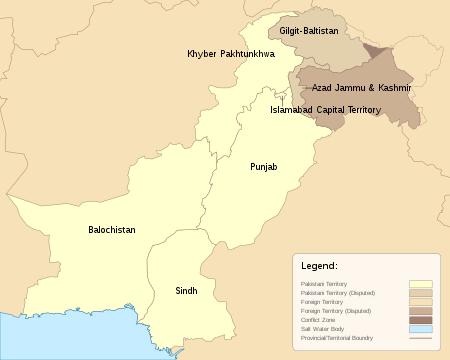
A federal parliamentary republic state, Pakistan is a federation that comprises four provinces: Punjab, Khyber-Pakhtunkhwa, Sindh, and Balochistan.[177] and fourterritories: the Tribal belt, Gilgit–Baltistan, Islamabad Capital Territory, and Kashmir. The Government of Pakistan exercises the de facto jurisdiction over the Frontier Regions and the western parts of the Kashmir Regions, which are organised into the separate political entities Azad Kashmir and Gilgit–Baltistan (formerly Northern Areas). In 2009, the constitutional assignment (the Gilgit–Baltistan Empowerment and Self-Governance Order) awarded the Gilgit–Baltistan a semi-provincial status, giving it self-government.[178]
The local government system consists of a three-tier system of districts, tehsils and union councils, with an elected body at each tier.[179] There are about 130 districts altogether, of which Azad Kashmir has ten[180] and Gilgit–Baltistan seven.[181] The Tribal Areas comprise seven tribal agencies and six small frontier regions detached from neighbouring districts.[182]
Clickable map of the four provinces and four federal territories of Pakistan.
 Law enforcement is carried out by a joint network of the intelligence community with jurisdiction limited to the relevant province or territory. The National Intelligence Directorate coordinates the information intelligence at both federal and provincial level; including the FIA, IB, Motorway Police, and paramilitary forces such as thePakistan Rangers and the Frontier Corps.[183]
Pakistan's "premier" intelligence agency, the Inter-Services Intelligene (ISI), was formed just within a year after the Independence of Pakistan in 1947.[184] Inter Service Intelligence Agency of Pakistan was ranked as the top intelligence agency in the world in 2011, 2014 and 2015.[185][186]
The court system is organised as a hierarchy, with the Supreme Court at the apex, below which are High Courts, Federal Shariat Courts (one in each province and one in the federal capital), District Courts (one in each district), Judicial Magistrate Courts (in every town and city), Executive Magistrate Courts and civil courts. ThePenal code has limited jurisdiction in the Tribal Areas, where law is largely derived from tribal customs.[183][187]


0 Comments